



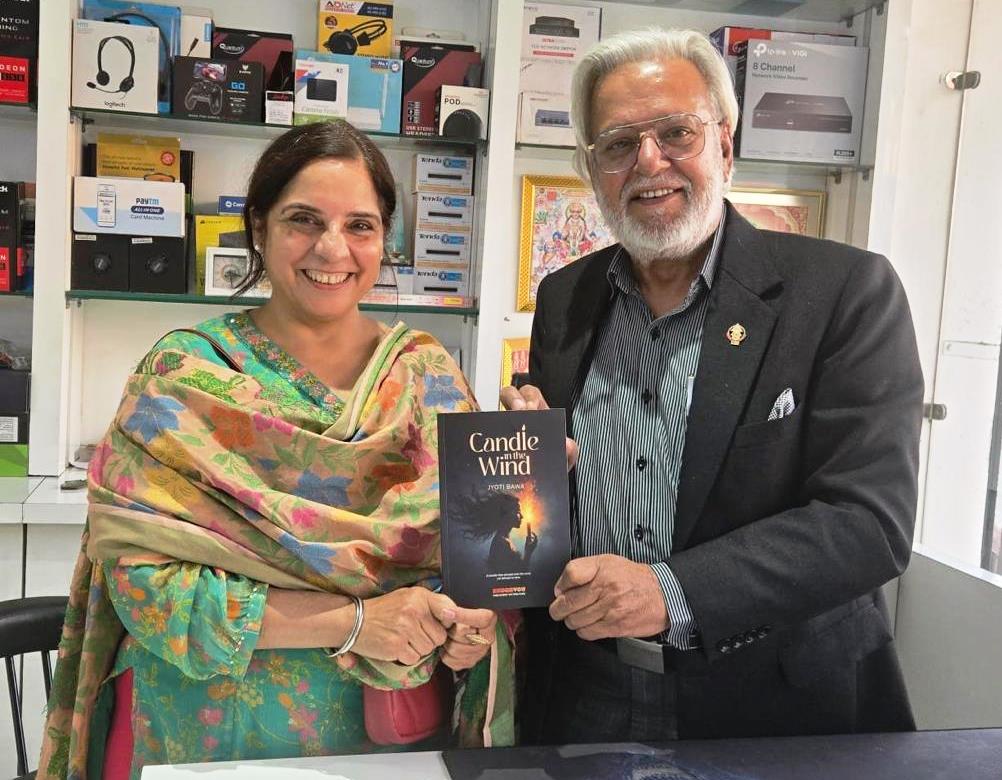
Book Review of Candle in the Wind: A Journey from Silence to Social Rebellion
Book Review of Candle in the Wind: A Journey from Silence to Social Rebellion
Title: Candle in the Wind
Author: Jyoti Bawa
Publisher: EEDEEYOU Publishers & Distributors, Kerala
Reviewer: Harish Monga
In an era where social issues are often reduced to mere statistics, Jyoti Bawa’s Candle in the Wind emerges as a poignant, non-fictional compilation that breathes life into the struggles of the marginalized. Far from a conventional novel, this book is a dramatic yet deeply accessible exploration of the rot within our social fabric and the resilience required to mend it. It is the story of a “candle” that danced with the wind and, despite the gusts of adversity, refused to bow.
The narrative is rooted in Bawa’s own transformation—a journey from a silent observer to a proactive social changemaker. Influenced heavily by her personal family history and her interactions with figures like K.S. Goraya, the author argues that true reform does not begin with systemic overhauls, but with a shift in individual mindsets. The book serves as an autobiography of experience, detailing Bawa’s encounters with various social strata and her evolution into a voice for the voiceless.
What sets this work apart is its structural clarity. Each chapter tackles a distinct “burning issue”—ranging from the horrors of rape and drug abuse to the often-ignored lives of the transgender community (Khusras), the “flesh bazaar,” and the stigmas surrounding menstruation. Bawa handles these daring topics with a sophisticated touch, ensuring that the reader is not just left with the grim reality of the problem, but is also provided with a viable solution or a “remedy” at the end of every chapter.
The book is a treasure trove of profound “punchlines” that demand to be quoted and revisited. Bawa’s insights into modern life are particularly piercing; she notes of our digital age: “We scroll but we rarely feel; we share but we don’t really connect.” Her focus remains steadfast on the “girl gender class,” offering hauntingly beautiful reminders like, “When we save our daughters, we save our future.” From the “whispers” of a suppressed girl to the “rebellion” of an empowered woman, the content maps the entire route of a woman’s journey beyond mere numbers.
The literary craftsmanship is bolstered by the collaborative effort of Gireesh Damodaran, who helped translate Bawa’s raw, fragile, and “trembling” thoughts into a powerful English narrative. The physical quality of the book also deserves mention; EEDEEYOU Publishers have delivered an aesthetically pleasing volume with thoughtful cover design and reader-friendly typography that complements the gravity of the text.
Ultimately, Candle in the Wind is a call to action. It highlights the commendable role of corporate social responsibility (CSR) and Bawa’s own grassroots work in rural and educational institutions. This is not a book meant to gather dust on a library shelf. It is a vital manual for today’s youth—both boys and girls—to help them feel the pulse of crime victims and understand that the power to change society lies not outside, but within. It is a compelling appeal to change our perspective and behaviour, proving that the best counsellor one can ever have is the voice found through self-reflection.