


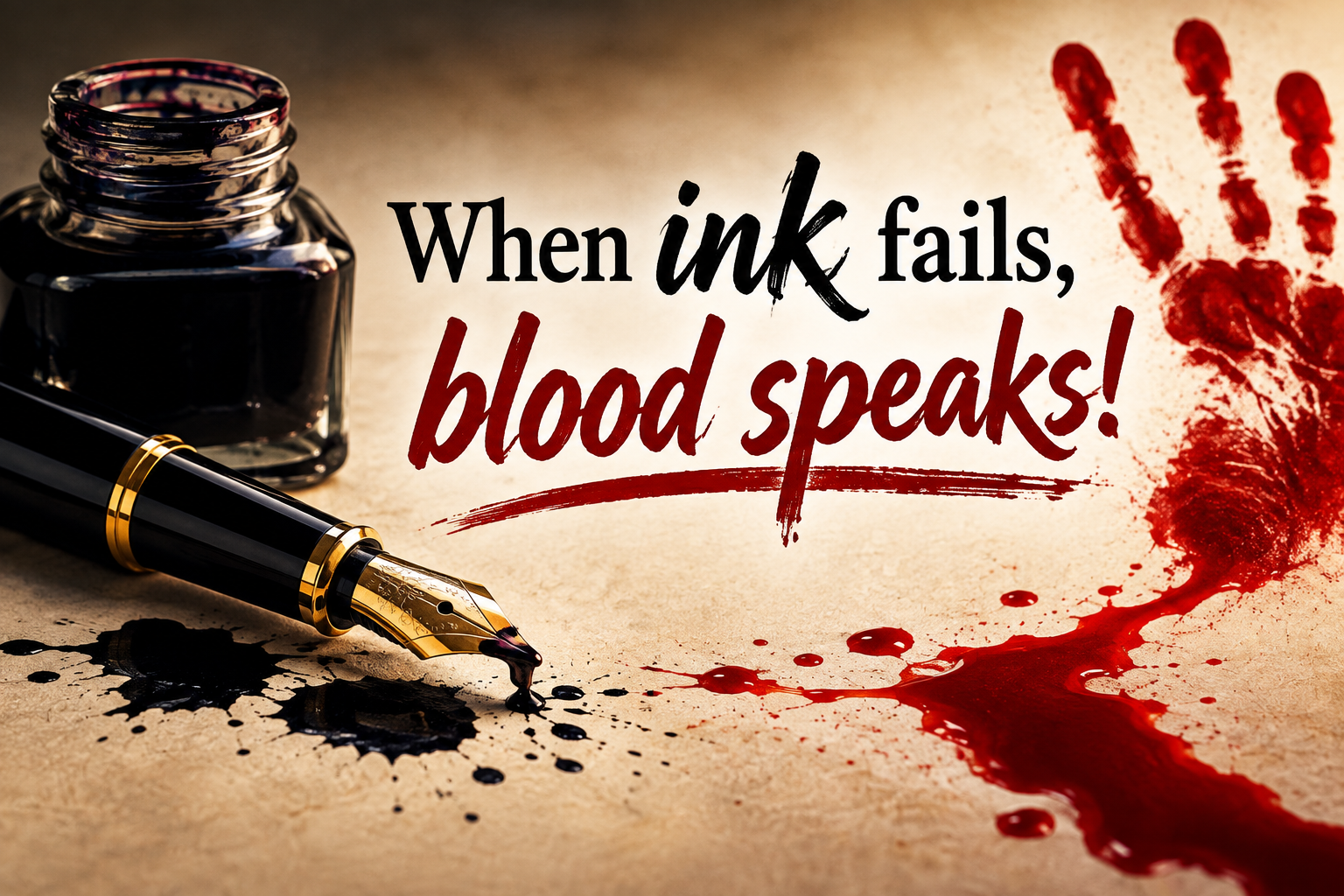
When ink fails, blood speaks!
When ink fails, blood speaks!
Friends, let me begin with a question—
Why would a person write a letter in blood to convey their message?
In today’s digital age, a message, email, or social media post can reach even the most prominent figures within seconds. Yet, people sometimes write letters in blood addressed to the Prime Minister, Chief Ministers, or other dignitaries.
History offers many unusual and dramatic examples of letters written in blood. At times, this has been a method of extreme protest; at others, an expression of passionate devotion, or a way to make an event unforgettable.
In India, too, citizens and youth groups have occasionally sent letters written in blood or blood-soaked petitions to high-ranking officials regarding serious demands and grievances.
Indeed, the number of “letters written in blood”—whether as a form of protest or an emotional appeal—has been striking, particularly in India. Some notable and documented instances include:
Incidents of people writing letters in blood to register a protest or make an emotional appeal have surfaced in India from time to time. In 2016, a daughter in Uttar Pradesh wrote a letter in blood to the Chief Minister, pleading for justice regarding her mother’s suspicious death. In 2017, students from Allahabad University sent a letter written in blood to the Prime Minister concerning hostel-related issues. In 2019, the Hindu Mahasabha claimed to have sent 101 letters written in blood to the Prime Minister. In 2020, farmer leaders wrote letters in blood regarding agricultural laws and demands for MSP. In 2023, the Karnataka Rakshana Vedike (regarding the Cauvery water dispute), an NCP worker (regarding Sharad Pawar’s resignation), and female students from Ghaziabad all resorted to writing letters in blood to voice their respective demands and grievances. In 2024, West Bengal BJP leader Kaustav Bagchi appealed to the Prime Minister to “save Bengal,” while Darjeeling MLA Neeraj Zimba sent a letter written in blood concerning the Gorkha issue. In 2026, youths in Bhiwani raised voices through blood-written letters about the NEET controversy; residents of Sindi Railway in Maharashtra demanded a rural hospital; women in Himachal protested; and young people protested against UGC regulations.
These blood letters show that writing in blood has become an extraordinary way to symbolically express protest, pain, frustration, and the seriousness of one’s demands.
Their message is clear—
“Our concerns must be heard urgently.”
I recall an incident from my journalism career.
A man approached me. He explained that his daughter had written a letter in blood addressed to Prime Minister Narendra Modi. He requested that news about this letter be published.
The issue involved a government department that had rented a building but had left the rent unpaid for a long time. This sum of money was crucial for the family.
The girl wrote the letter to the Prime Minister in blood.
I reported on the matter.
As soon as the news broke, the Deputy Commissioner took immediate action, instructed the concerned department to release the payment, and eventually, the outstanding amount reached the building owner’s account.
I was happy that my report helped a needy family.
But to be honest, I later felt—
The real power lay not in my news report, but in that girl’s letter written in blood.
That letter had captured the system’s attention.
But this raises a major question—
Should a citizen ever need to write a letter in blood to secure their legitimate rights?
In my opinion, absolutely not.
If a person is owed a legitimate payment and rules and instructions for its release already exist, action should be taken following a standard application—not only after a blood-written letter.
And there is a practical aspect, too—writing in blood is neither a standard nor a safe method of communication. Handling or mailing human blood can raise health and postal safety concerns. Therefore, rather than encouraging such dramatic gestures, it is far more important to address the underlying grievances promptly.
After all, the efficiency of a system should not be defined by whether work gets done only after seeing a letter written in blood. True efficiency lies in—
Getting legitimate work done on time, even without a letter written in blood.
So, the next time you encounter a letter written in blood, do not just ask—
“Why did they do this?”
Also ask—
“What circumstances drove them to this?”
Perhaps this very question could make our system more responsive, sensitive, and accountable.
Writing letters in blood has been an extreme form of protest and emotional appeal. In India, people have written such letters regarding issues like NEET, UGC rules, the farmers’ protest, the Cauvery water dispute, Sharad Pawar’s resignation, and matters concerning justice. The aim was not merely to voice an opinion but to highlight urgency, pain, commitment, and desperation. The question remains—does a letter written in blood truly make a voice more impactful, or is it a sign of growing frustration with the methods of democratic protest?